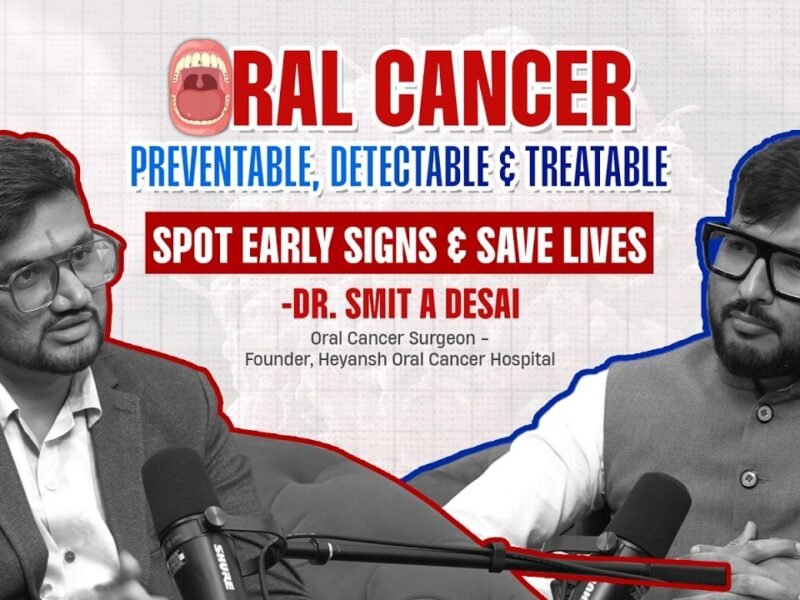
What Causes Oral Cancer? A Surgeon Separates Cause from Myth
Oral cancer surgeon Dr Smit A. Desai explains how repeated irritation leads to cancer, why plain supari counts, and which popular beliefs have no evidence.
"My friend chews far more than I do, and nothing happened to him." Or the other version: "I only eat plain supari, nothing else." Dr Smit A. Desai, Consultant Oral Cancer Surgeon and founder of Heyansh Hospital in Ahmedabad, says he hears both in his clinic, often on the same day. Both statements rest on a misunderstanding of how oral cancer begins.
What is cancer, in simple words?
Dr Desai describes cancer as "excess" of something. In the body, he explains, thousands of cells die every day and thousands of new ones are made. This cycle of wear and repair is normal and ongoing.
Trouble starts when something keeps irritating the same spot. The tissue is scraped, it heals, it is scraped again. Over time, he says, the body forgets when to stop. The healing process keeps running, cells that should die at their natural time do not, and the result is uncontrolled growth.
Why plain supari, gutka and mawa all matter, and why not everyone gets cancer
According to Dr Desai, tobacco, supari, gutka and mawa are the main reasons for oral cancer in India. He points out that even plain supari can cause trouble if it is held in one place in the mouth for long periods. Some patients tell him they chew only plain supari, and he says this does not make it safe. Some people even sleep with it tucked in the cheek.
He adds that cancer of the inner cheek lining is formally called the "Indian cancer" at conferences, because tobacco is rarely held in the cheek in other parts of the world.
So why do some heavy users escape? Dr Desai says the five fingers of the hand are not equal. One person's cheek lining may get irritated by two spoonfuls of masala, while another can take twenty without any change. The lining responds differently from person to person. His blunt answer to "my friend does more and he is fine" is that the friend may simply not have been affected yet.
Causes that have nothing to do with addiction
Dr Desai notes that some people who have never chewed or smoked still reach his outpatient department. He names a few causes of repeated irritation:
- A sharp tooth that keeps hitting the same spot on the cheek or tongue.
- Ill-fitting or sharp dentures that rub, even in someone with no habit at all.
- Chronic acidity or gastric reflux, especially with late-night eating and sour belching, which can burn the lining of the mouth. He mentions long-standing diabetes with acidity in this context.
Still, he is candid about the overall picture. Of ten patients he sees, he says nine have had some addiction at some point in their lives. He does not want the rare exception used to excuse the habit.
His practical advice is a dental check-up every six months. Abroad this is routine, he says, but in India many people see a doctor only when something hurts.
Children, hookah and vaping
Dr Desai says he has operated on children as young as 10 and 12 with the typical oral cancer seen in adults. When he asked the families, the story was similar. Parents from labouring families, working all day on sites, would place supari in a crying child's mouth to keep the child quiet while they worked. The child began at five or six years old, the habit set in, and it was repeated daily.
He separates this from the blood cancers more common in young children, which are treated by medical oncologists.
On hookah and vaping, he warns about what he calls reverse smoking. The heat is taken to an extreme level and the smoke is held in the mouth before being let out. He says this is quite different from ordinary cigarette smoking and that it is mainly linked with cancers of the oropharynx, the area at the back of the mouth and throat.
Myth or fact: what he says about common beliefs
- Sugar causes or speeds up cancer. Dr Desai calls this a myth, saying there is no evidence for it. Sugar does reduce the body's healing capacity, as seen in diabetes, but that is a different point. He has also seen patients stop sugar entirely and end up needing glucose drips during treatment.
- Cancer is always inherited. Some cancers, such as breast and rectal cancer, have established evidence of running in families. For oral cancer, he says nothing like that is proven. It comes mainly from habits, especially tobacco.
- Mobile phones, deodorants or toothpaste cause cancer. He says there is no evidence for these.
- Diet alone can cure cancer. In his words, diet and nutrition alone cannot treat cancer. He was asked about this after a public claim of a diet-only cure, and calls it a myth.
- Herbal or alternative medicines cure oral cancer. He says he respects every system of medicine, but treatment should rest on evidence from trials that are repeated and updated every year across large groups of patients.
- A doctor can promise a 100 percent cure. He says no honest cancer surgeon can, himself included. Anyone offering a guarantee, he says, should be treated with caution.
He also warns that months spent on home remedies and shrine visits are time lost, because the disease keeps progressing meanwhile.
Key takeaways
- Dr Desai explains cancer as cells that forget when to stop after repeated injury and healing.
- Tobacco, gutka, mawa and even plain supari held in the mouth can all cause it.
- Sensitivity varies from person to person, so a friend being fine proves nothing.
- Sharp teeth, rough dentures and chronic acid reflux can also irritate the mouth lining.
- Children given supari to keep them quiet can develop oral cancer.
- Hookah (reverse smoking) and vaping are a concern for the mouth and throat.
- Sugar, mobile phones and diet-only cures are myths, and no one can promise a 100 percent cure.
- A dental check-up every six months is his simple advice. If you have a concern about your own mouth, see a qualified doctor.
Common questions
Can plain supari cause oral cancer?
Yes, according to Dr Desai. Even plain supari can cause trouble if it is held in one place in the mouth for long periods. The repeated irritation is what matters.
Why do some people who chew tobacco never get oral cancer?
Dr Desai says the lining of the mouth responds differently in different people. One person may be irritated by a small amount, while another tolerates much more. Not having a problem yet does not mean the habit is safe.
Can you get oral cancer without any tobacco habit?
Dr Desai says yes. A sharp tooth that keeps hitting one spot, ill-fitting dentures, and chronic acid reflux can all irritate the lining. He adds that most of his patients, about nine in ten, have had some addiction.
Does sugar cause oral cancer or make it grow faster?
Dr Desai calls this a myth and says there is no evidence for it. Sugar can reduce the body's healing capacity, especially in people with diabetes, but that is not the same as causing cancer.
Is oral cancer hereditary?
Dr Desai says some cancers, such as breast and rectal cancer, have established evidence of running in families. For oral cancer, nothing like that has been proven. He says it mainly comes from habits, especially tobacco.
Are hookah and vaping a risk for the mouth and throat?
Dr Desai warns that hookah involves reverse smoking, where very high heat is taken in and smoke is held in the mouth. He says cancers of the oropharynx are mainly linked with vaping and hookah use.
This article is for general education. It is not a substitute for a consultation with a qualified doctor.
More on Medvyn
 Health insight
Oral Cancer Self-Check: Five Minutes in the Mirror Can Catch It Early
More with Dr Smit A. Desai
 Health news
Netaji Subhas Medical College Gets NMC Nod for 44 More PG Seats
New · 5 hours ago
Doctor's toolkit
How to Build a Single-Disease Hospital Around a Dedicated Team
New · 5 hours ago