Dr Alpesh Prajapati: From a Tea Stall to a 108-Bed Hospital in Kadi
Dr Alpesh Prajapati, a tea-stall owner's son who topped Mehsana district, built a 108-bed hospital so Kadi's patients need not travel to Ahmedabad for emergencies.
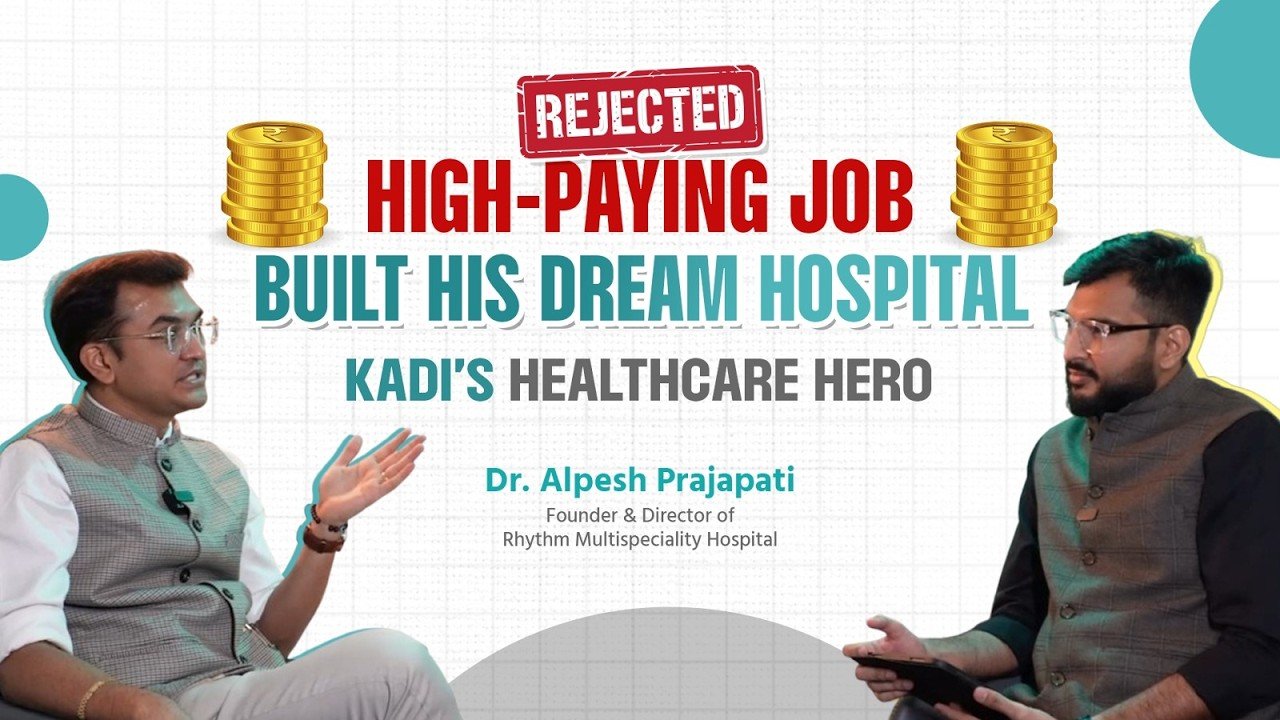
One night, a patient walked into Dr Alpesh Prajapati's hospital in Kadi at around 10 pm. The patient had already been treated elsewhere and had come hoping he could help. The patient needed emergency dialysis, and at that hour no one in Kadi could provide it.
He had to refer the patient to Ahmedabad, about an hour away. The patient died on the road.
"This is not acceptable at all," Dr Prajapati remembers thinking that night. A patient may choose to go to Ahmedabad, he says, but no one should have to go because treatment is unavailable. That conviction later became a 108-bed multispeciality hospital. Almost everyone he consulted told him it could not work.
A tea stall, a diploma and a district rank
Dr Prajapati, an M.D. in Medicine, grew up in a modest family. His father ran a tea stall. When he topped Class 10 in Kadi, the advice at home and around him was practical: do a diploma, finish early, and help the family.
His school stepped in. The management of Sarva Vidyalaya High School waived his Class 11 and 12 fees, and teachers offered extra classes at no charge. "That gave me courage," he says.
Then, two days before his Class 12 science paper, his father became seriously ill with diabetes complications and was put on a ventilator. The family was told his chances were slim. Dr Prajapati sat the exam, in his words, almost blindly. He had spent the year writing out answers rather than only reading, and the habit may have helped.
He came first in Mehsana district in Class 12 science. A newspaper headline noted that a tea-stall owner's son had topped without tuition.
The offer that made MBBS possible
The real struggle began after the result. College fees, books and hostel costs were out of reach. Well-wishers again suggested a short PTC teaching course. Dr Prajapati spent part of that vacation selling tea at his father's stall, and he had nearly settled on PTC.
Then a Kadi teacher, Soni sir, passed word to a man from a nearby village who lived in the US. The man had seen the newspaper report and wanted to educate the boy. After a late-night meeting, he offered to cover the entire cost of his MBBS.
Dr Prajapati joined BJ Medical College in Ahmedabad. Money stayed tight. He says he cannot recall a single trip with friends outside Ahmedabad during those years. He looks at their old photographs and feels he missed that time.
After MBBS he considered stopping, taking a government medical officer's post and settling down. His parents pushed him to continue. He cleared NEET PG on his first attempt and took M.D. Medicine.
Why medicine, and why diabetes
He had decided early that he would not go into surgery. His father's illness explained why. When the family had moved to Deesa during a financial crisis, a visiting physician took over his father's case and changed the treatment. His father recovered.
"A patient at home and this miracle, together, settled it in my mind," he says. He wanted to work in medicine, with a focus on diabetes.
A lower salary and a smaller hospital
After his M.D., offers came in. One hospital proposed Rs 1.5 lakh a month as a full-time physician. A small old trust hospital in Kadi, short of a physician, could offer Rs 70,000.
He chose Kadi. "Whatever I am, I am because of Kadi," he says. Kadi had backed him through Classes 11 and 12, and he wanted to give something back. His family agreed. His father, who had taken loans during the illness, wanted him to serve people as poor as they had once been.
He began with zero outpatients and reached 50 to 60 a day in six months. Then the trust owners decided to run the hospital themselves, and the team had to leave.
He joined Bhagyoday Hospital as a full-time physician. At the time, he says, no physician was available there after 6 pm, and emergencies were sent to Ahmedabad. He began with about 45 outpatients a day. He recalls one Monday with 289, ending at 10 pm without lunch. For years he slept on a table in the trustees' meeting room across from the emergency ward so he would be on hand at night.
Trustee support grew. A donation helped expand a four-bed ICU, and new rooms were added. During a visit to see another hospital's ICU, his car met with a serious accident. He escaped with rib and leg fractures and calls that day a second life. It made him decide not to stop there.
Rhythm, and the building everyone doubted
After about three and a half years, he started his own hospital, Rhythm, in rented space with limited facilities. Covid arrived there. The third-floor complex had poor upkeep and water problems, and he was not satisfied with the setup. Lack of funds delayed a move for years, and he spent five and a half years in the old space.
The dialysis death changed his plans. He approached a builder who was constructing a complex and proposed a "doctor house", with each specialty represented once so doctors would not compete in the same building. He had initially imagined a floor or two for about 40 to 50 beds.
Local doctors and investors declined. "Not one person did not tell me this project cannot be done," he says. They argued that Kadi, with about a lakh people and Ahmedabad an hour away, could not support a multispeciality hospital.
Tie-ups with Ahmedabad hospitals fell through over policies he could not accept, including a rule against reducing bills without permission. He wanted to waive or reduce fees for poor patients. He took more floors at his own risk, and when partners withdrew he had already committed to roughly 60,000 sq ft. "Then there was no option. I closed my eyes, took God's name and got to work."
The new Rhythm opened in September, with a cath lab and cardiology team under the name Arogya Heart Care. Specialists in gastro-surgery, orthopaedics and gynaecology are full-time, and he says they live in Kadi and can reach the hospital within five to ten minutes. The hospital is open to other doctors who want to admit and treat their own patients there.
He has applied for Ayushman Card empanelment. Colleagues warned him the premium infrastructure would not survive it. He answered that everyone has a right to the same healthcare, and he says the general and paid wards share the same air-conditioning, beds and monitors.
What he still has to change
The biggest hurdle, he says, is mindset. Some families and doctors still send critical patients to Ahmedabad even when the care exists in Kadi. He describes a patient whose ECG had been normal the day before. When a repeat ECG at Rhythm showed a heart attack, the family declined admission and took him home. The patient died that evening. Dr Prajapati notes that heart attack symptoms can vary, from acidity to back pain, and a normal tracing earlier does not rule one out. Anyone with chest pain should see a doctor promptly.
He is also candid about the cost. He has missed holidays with his wife, a homoeopathic doctor and trained Kathak dancer, but says they treat it as a shared understanding.
His hope is simple: that over time Kadi's people stop assuming good care lives only in another city. "If we save even one or two deaths in that one hour," he says, "our effort is worth it."
More on Medvyn
 Health insight
Guillain-Barré Syndrome: When Weakness Climbs From the Legs Upward
More with Dr Alpesh Prajapati
Health insight
Can a Normal ECG Yesterday Rule Out a Heart Attack Today?
More with Dr Alpesh Prajapati
 Health news
Zydus Hospital Ahmedabad Named ‘Best Hospital in Ahmedabad’ for the 8th Consecutive Year
New · 2 hours ago