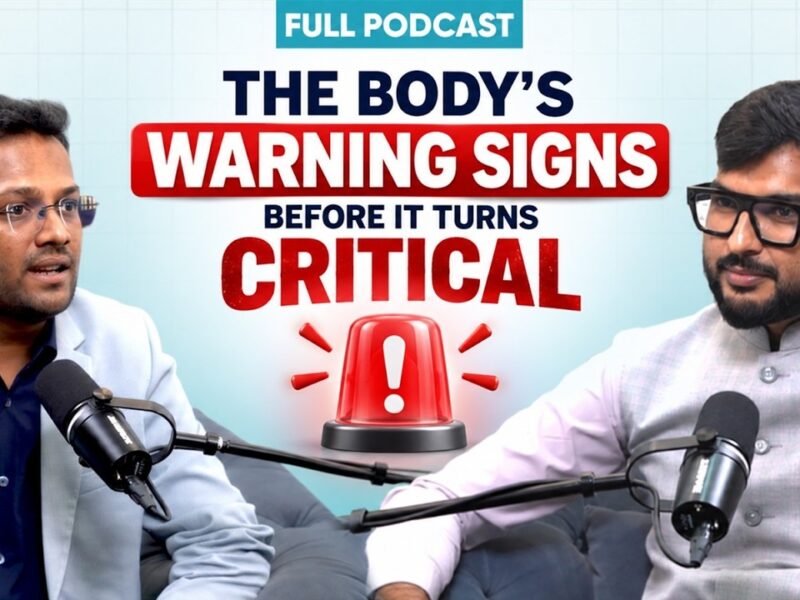
Can a Normal ECG Yesterday Rule Out a Heart Attack Today?
Dr Alpesh Prajapati explains why an earlier normal ECG cannot be trusted when chest discomfort continues, and why treatment options and hospital backup matter in a serious heart attack.
A person has chest discomfort and gets an ECG. The report is normal, everyone relaxes, and the pain carries on at home. The next day it is still there. Does yesterday's normal report mean the heart is fine today?
Dr Alpesh Prajapati, M.D. (Medicine), who practises at Rhythm Multispeciality Hospital in Kadi, Mehsana, says it does not. He has seen this reasoning cost lives.
Why a normal ECG from yesterday does not settle the question
Dr Prajapati recalls a recent emergency in which a patient with pain had a normal ECG at another hospital the previous day. When the ECG was repeated at his hospital, it showed the effects of a heart attack. The family argued that the earlier report was normal, that the pain had not increased, and that the patient was walking around comfortably.
He explained to them that a heart attack can happen within five minutes. The family did not accept this, took the patient home against advice, and the patient died that evening, he says.
An ECG records the heart at one moment. A report from yesterday describes yesterday. If symptoms continue or change, the heart needs to be checked again today.
Why a heart attack does not always feel like one
Many people expect a heart attack to be dramatic and unmistakable. Dr Prajapati says it often is not. According to him, a patient may feel what seems like acidity, a pain in the chest, or a pain in the back.
He adds another point that surprises many families. Sometimes the heart attack has already happened, and it has caused the blood pressure to fall. The low blood pressure then produces symptoms of its own. The patient may look and feel unwell without the classic picture people have in mind.
This is why he asks families to accept that an attack is possible even when the pain seems mild, and even when the person is up and about.
What are the two routes of treatment in a serious heart attack?
Dr Prajapati describes two main options for a patient who arrives with a severe heart attack:
- An injection to dissolve the clot in the heart's artery.
- Angiography followed by a stent, placed directly in the blocked artery.
He says that relatives sometimes ask the doctors to start with the injection and decide about angiography later. This is especially common when the patient has come with someone who cannot take decisions for the family. The doctors can do that, he says, but the next step depends on how the patient responds.
What if the injection does not work?
If the injection dissolves the clot and the ECG changes improve, the patient's life is saved and doctors can afford to wait, Dr Prajapati explains.
But he says that in many cases the artery does not open even after the injection. In those patients, repeated attacks and irregular heartbeats can continue. The condition can become unstable within hours.
That is where backup matters. A hospital with a cath lab, the room where angiography and angioplasty are done, can take such a patient straight in and treat the blocked artery without delay. Dr Prajapati notes that the same facility is useful when a heart attack has led to very low blood pressure, a very slow heartbeat, or an irregular rhythm that needs a pacemaker or an ICD. It also helps when a patient was given a clot-dissolving injection elsewhere and still has symptoms.
Why distance and time matter
Dr Prajapati's reasoning for building a cath lab in Kadi came from what he saw earlier in his career. Without an option nearby, patients had to be sent to Ahmedabad, about an hour away, and some did not reach it alive or arrived too sick to be saved.
His point is not that every patient should stay in a particular town. It is that in a heart attack the hour on the road counts. The right treatment should be reachable as soon as the problem is recognised, whether that is close to home or farther away.
Key takeaways
- A normal ECG from an earlier day does not rule out a heart attack today.
- According to Dr Prajapati, an attack can develop within about five minutes.
- Symptoms may look like acidity, chest pain or back pain, and low blood pressure after an attack can itself cause symptoms.
- The two main routes are a clot-dissolving injection or angiography with a stent.
- The injection does not always open the artery, and repeated attacks or irregular heartbeats can follow.
- If chest discomfort continues or returns, get checked promptly by a qualified doctor and repeat the tests instead of relying on an old report.
Frequently asked questions
Common questions
Can a normal ECG yesterday rule out a heart attack today?
No, says Dr Prajapati. He describes a case where an ECG that was normal the day before showed a heart attack when repeated. A heart attack, he says, can come within five minutes, so symptoms today need a fresh check.
Can a heart attack feel like acidity or back pain?
Yes. Dr Prajapati says patients may feel acidity, chest pain or back pain during a heart attack. The symptoms are not always the dramatic ones people expect.
Why can low blood pressure be a sign of a heart attack?
Dr Prajapati explains that sometimes the attack has already happened and has caused blood pressure to fall. The low blood pressure then causes the symptoms the patient feels.
What are the treatment options in a serious heart attack?
Dr Prajapati describes two routes. One is an injection that dissolves the clot. The other is angiography followed by a stent. Which is used depends on the patient's condition and how they respond.
What happens if the clot-dissolving injection does not work?
Dr Prajapati says the artery does not always open after the injection. Repeated attacks and irregular heartbeats can continue, so the patient may need angiography straight away. This is why a cath lab as backup is important.
Should I wait and watch if chest discomfort is mild?
Dr Prajapati's experience suggests not relying on an earlier report or on the fact that the pain has not worsened. If chest discomfort persists or returns, see a qualified doctor promptly so the heart can be checked again.
This article is for general education. It is not a substitute for a consultation with a qualified doctor.
More on Medvyn
 Health insight
Guillain-Barré Syndrome: When Weakness Climbs From the Legs Upward
More with Dr Alpesh Prajapati
Doctorpreneur story
Dr Alpesh Prajapati: From a Tea Stall to a 108-Bed Hospital in Kadi
More with Dr Alpesh Prajapati
 Health news
Zydus Hospital Ahmedabad Named ‘Best Hospital in Ahmedabad’ for the 8th Consecutive Year
New · 1 hour ago