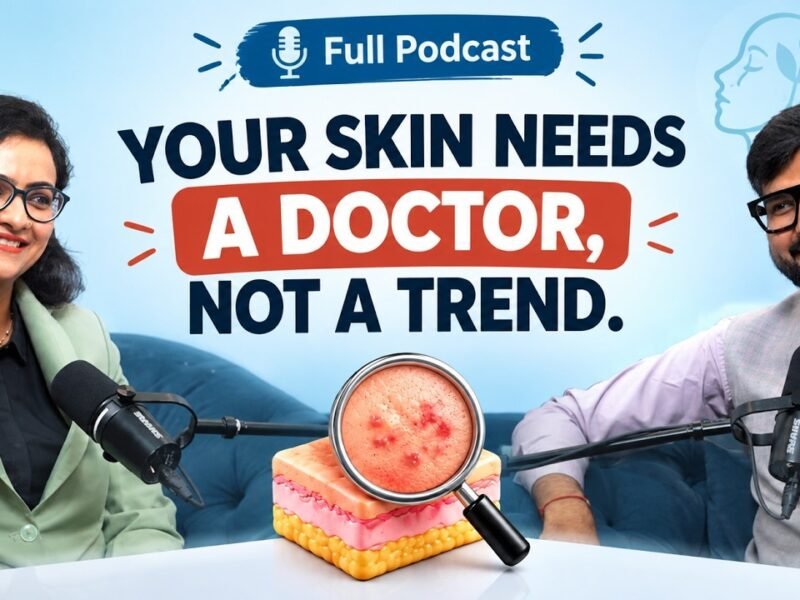
Why Pimples Keep Coming Back and When to See a Dermatologist
Dr Vaishali Makwana explains why acne returns, how family tendency and oil production play a part, and when painful pimples need a dermatologist to prevent scars.
The pimple clears, the cream goes back in the drawer, and a few weeks later another one arrives. Many people conclude that their skin is simply difficult. According to Dr Vaishali Makwana, an MD in Skin & VD practising in Surendranagar, the pattern usually has a more ordinary explanation.
Why do pimples appear in the first place?
Dr Makwana says acne has several causes, and no single one explains everything. She names three main ones.
- Family tendency. If a sister or mother has had acne, you may be more likely to get it too.
- Inflammation in the skin.
- Oil production. After the age of 12 to 13, the oil glands of the face become more active. The same change in the scalp is why dandruff begins around this age.
Because acne has many causes, she describes it as multifactorial. Her approach reflects that: lifestyle changes, proper treatment, and a long-term maintenance plan.
Why does acne keep coming back?
The most common reason, Dr Makwana explains, is stopping treatment too early. People use medicine or cream for a month or two, see some improvement, and quit. The acne then returns, and the cycle repeats.
She also gives a rough timeline. Acne usually begins at 12 to 13 years of age and can continue until about 30, after which hormones tend to settle on their own. Acne in puberty is common and expected. The real question is when it needs medical attention.
When should you see a dermatologist?
Dr Makwana says acne should be taken seriously when it reaches grade 3 or grade 4. These are the stages with fluid-filled or pus-filled pimples that are very painful. Treatment is essential here, she says, because untreated acne can leave marks and pits, which are acne scars. She adds that scars are harder to treat than the pimples themselves.
Age matters too. Acne that starts after 35 is a different kind, called adult-onset acne. Dr Makwana says it can come from hormonal imbalance or from certain medicines. She gives vitamin B12 injections as one example. Since the cause is different, the whole approach to treatment is different, and she advises seeing a dermatologist who can look into the cause in depth and plan maintenance treatment accordingly.
Do face wash and food choices make a difference?
Dr Makwana suggests a few simple habits, especially for those who get repeated breakouts.
Use a face wash instead of soap. She says a face wash cleanses better. Acne face washes often contain ingredients such as glycolic acid or salicylic acid, which help control oil and have an antibacterial effect. In oily skin, she notes, soap may not clean the face properly, and soap particles can be left behind. Some face washes also contain kojic acid, glutathione or vitamin C, which can help lighten dark spots.
Cut down on certain foods. She advises eating less spicy and fried food, and less of high-glycaemic foods, meaning sugary items such as cake, pastry and ice cream. Milk products and protein powder can also trigger acne breakouts, she says.
Be careful with hair oil. If you get acne, she advises not using hair oil.
If you follow these steps, she says, the repeated pimples can reduce. She presents this as a way to lessen breakouts, not a guarantee.
What treatments are available for acne and its marks?
Acne treatment is not always surgery, Dr Makwana clarifies. Most often it begins with medicines, creams to apply and a prescribed face wash. Beyond that, she mentions:
- Chemical peeling for acne.
- Certain lasers for acne.
- Laser skin resurfacing once the acne has settled, for the spots and scars it leaves behind, done in sessions.
She also cautions against sharing creams with friends. A cream prescribed for acne is a medicine with a specific ingredient strength, she explains, and it comes with instructions, such as applying it at night for a set number of hours. Someone who uses it without those instructions may end up with irritation or burns. What worked for one person may not suit another. Because skin type and the cause of acne differ, it is worth speaking to a qualified dermatologist about your own skin.
Key takeaways
- Acne comes from a mix of family tendency, inflammation and increased oil production after age 12 to 13.
- Stopping treatment as soon as skin improves is a common reason acne returns.
- Grade 3 and grade 4 acne, with painful, pus-filled pimples, should be treated, as it can leave scars that are harder to treat than the acne.
- Adult-onset acne after 35 can be linked to hormones or some medicines and needs a different approach.
- A face wash is preferred over soap, and spicy, fried and sugary foods, dairy and protein powder may trigger breakouts.
- Creams, peels and lasers are options, and prescribed creams should not be shared.
Common questions
Why do I still get pimples as an adult?
Dr Makwana says acne usually settles by around 30 as hormones balance out. Acne that starts after 35 is called adult-onset acne and can be due to hormonal imbalance or certain medicines. The cause needs to be examined in depth, and the treatment is quite different.
When is a pimple serious enough to see a skin doctor?
Dr Makwana says grade 3 and grade 4 acne should be treated. These are fluid-filled or pus-filled pimples that are very painful. Without treatment they can leave marks and pits, and acne scars are harder to treat than acne.
Why does acne return after I stop my cream?
According to Dr Makwana, many people use medicine or cream for a month or two, improve a little and then stop. This leads to recurrence. Acne needs proper treatment along with long-term maintenance.
Is face wash better than soap for acne-prone skin?
Dr Makwana says a face wash cleanses better than soap. Acne face washes can contain glycolic or salicylic acid, which help control oil and have antibacterial properties. Soap may not clean oily skin well and its particles can remain on the face.
Which foods can worsen acne?
Dr Makwana advises eating less spicy and fried food, and less of sugary, high-glycaemic items like cake, pastry and ice cream. She also says milk products and protein powder can cause acne breakouts.
How are acne scars treated?
Dr Makwana says laser treatment, called skin resurfacing, is used for spots and scars after the acne has cleared. It is done in sessions. Chemical peels and certain lasers are also used for acne itself.
This article is for general education. It is not a substitute for a consultation with a qualified doctor.
More on Medvyn
 Doctorpreneur story
From Junagadh to Surendranagar: Dr Vaishali Makwana on building a skin and hair clinic
More with Dr Vaishali Makwana
 Health insight
Hair Fall: Causes, When to See a Doctor and What Helps
More with Dr Vaishali Makwana
 Health news
Indian American physician funds infectious disease program at Pune medical college
New · 9 hours ago