Oral Cancer Surgery: What to Expect and How Rebuilding Works
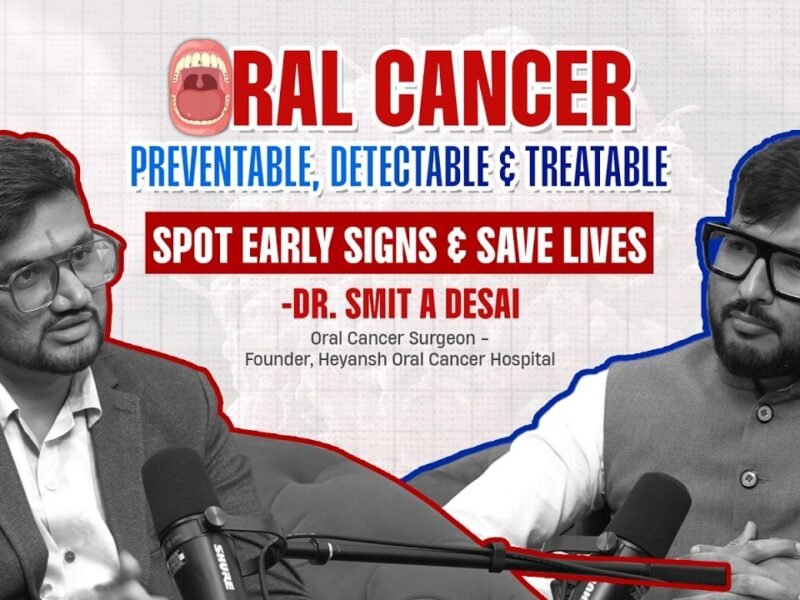
Dr Smit A. Desai explains how oral cancer surgery is planned, how the jaw or tongue is rebuilt, and why a longer operation is not a better one.
The first question many people ask an oral cancer surgeon is not about survival. It is about their face. Will the mouth look crooked? Will the jaw change? Will I be able to eat and talk, and go back to my life?
Dr Smit A. Desai, Consultant Oral Cancer Surgeon and founder of Heyansh Hospital in Ahmedabad, says these are the right questions. Everyone has to return to society after treatment, so how a patient looks and functions afterwards matters as much as the operation itself.
Why surgery is the main treatment for oral cancer
Dr Desai explains that in oral cancer, surgery is the curative treatment. If a cure is the aim, the operation cannot be left out. Stage then decides the rest of the plan, and treatment changes as the stage advances.
He describes three goals for the surgeon:
- Remove the cancer in a way that makes it unlikely to return.
- Rebuild what was removed so that normal form, function and appearance are preserved as far as possible.
- Help the patient go back into society comfortably.
He is candid that the rebuilt part will not be exactly like the original. He tells patients that nobody can fully complete what nature created. Surgeons come close, but not identical.
How the operation is planned
The diagnosis comes first, and Dr Desai says a biopsy is the standard test that confirms cancer. Scans then help decide how much needs to be removed and how much needs to be rebuilt.
Modern planning uses 3D printing. A model of the patient's skull is made to the patient's own measurements. The surgical and plastic surgery teams then perform a mock surgery on this model, on a table, before the real operation.
The bone template for the reconstruction is prepared from that rehearsal. The real operation happens the next day. Dr Desai says this saves a good deal of time in the operating theatre and reduces the time under anaesthesia, which is better for the patient.
Checking the margins during the operation
The surgeon removes the growth along with a margin of healthy tissue around it. During the operation, samples from the edges are examined on the spot. This is called a frozen section, or live biopsy.
Dr Desai says the report comes back in about 15 to 20 minutes. If it shows that cancer is still present, the surgeon removes more.
He also describes what he calls a minimally invasive approach, where the whole operation is done through a single incision. He says that afterwards, relatives may notice the scar only after a month or two, and a stranger would not be able to tell where the surgery was done.
How the jaw is rebuilt with a free flap
When part of the jaw has to be removed, one option is a free flap, also called microvascular surgery. Bone is taken from the leg, shaped to match the removed jaw, and fitted into place. Its small blood vessels are then joined to vessels in the neck, using stitches finer than a strand of hair.
Dr Desai compares it to a bypass operation. The joined vessels must be left undisturbed for at least 72 hours. During this time the patient has to stay in one position. His team has developed special pillows for this, and nurses, fellows and doctors check the patient round the clock, often every hour.
He describes it as a demanding operation that depends on teamwork. His team includes three surgeons and two plastic surgeons, along with assistants. He says it carries a risk comparable to bypass surgery, and does not call it a small procedure.
Why a longer operation is not a better one
Patients sometimes say that someone they know had a 10-hour operation, as if length means thoroughness. Dr Desai disagrees. He says that at established cancer institutes these operations usually take three to six hours. Very long operations may simply reflect a need for more training, and in the past, before planning improved, such surgeries could run 12 to 15 hours.
He also says no surgery is free of risk, and no honest surgeon promises 100 percent.
Recovery, speech and swallowing
Surgery is only part of the work. Dr Desai's team includes speech and swallowing specialists, and patients follow regular exercises, including video-guided ones. Where the jaw or palate has been removed, a maxillofacial prosthodontist can help restore it. The goal is for patients to eat without a feeding tube and to return to their personal, professional and social lives.
Recovery depends on stage. He says a patient with an early-stage cancer may be back to routine in about 10 days. Someone with advanced disease needs more removed and more rebuilt, takes roughly 20 percent longer, and should expect at least 21 to 30 days.
What about robotics and immunotherapy?
On robots, Dr Desai is measured. They are most useful for the back of the tongue (base of tongue) and the palate. Elsewhere in the mouth he sees no major contribution. Having a robot is helpful, he says, but a centre without one loses nothing.
Immunotherapy has a defined role in modern, evidence-based medicine. He describes it as a last hope when surgery, radiation and chemotherapy are not options, such as in cancer that cannot be operated on, and notes that it is costly. He is dismissive of claims that immunity can be raised by other means to cure cancer.
He also says the earlier the stage at surgery, the lower the chance of recurrence. Anyone with a mouth ulcer that has not healed in three weeks should see a qualified doctor, and anyone with a diagnosis should ask their own surgeon what to expect.
Key takeaways
- Surgery is the curative treatment in oral cancer, and stage decides the overall plan.
- The three aims are complete removal, rebuilding form and function, and returning to normal life.
- 3D models and mock surgery shorten the real operation.
- Frozen section gives an answer within about 15 to 20 minutes during surgery.
- Free flap surgery needs at least 72 hours of careful monitoring.
- A longer operation is not a better one. Most take three to six hours.
- Rehabilitation takes about 10 days for early cancers and 21 to 30 days for advanced ones.
Common questions
Is surgery the main treatment for oral cancer?
Dr Desai says surgery is the curative treatment in oral cancer. Radiation, chemotherapy and immunotherapy have roles, but treatment is decided by stage.
What is a frozen section or live biopsy?
During the operation, tissue from the edges of the removed area is checked straight away. Dr Desai says the report arrives in about 15 to 20 minutes. If cancer is still present, more is removed.
How is the jaw rebuilt after oral cancer surgery?
Dr Desai describes free flap surgery. Bone from the leg is shaped to match the removed jaw, and its blood vessels are joined to vessels in the neck. The connection must stay undisturbed for at least 72 hours.
How long does oral cancer surgery take?
Dr Desai says these operations usually take three to six hours at established cancer institutes. He says a longer operation does not mean a better one.
How long is recovery after oral cancer surgery?
According to Dr Desai, a patient with early-stage disease may be back to routine in about 10 days. Advanced-stage patients take about 20 percent longer, usually 21 to 30 days at minimum.
Does robotic surgery help in oral cancer?
Dr Desai says robots are mainly useful for cancers at the base of the tongue and the palate. Elsewhere in the mouth he sees little contribution, and says a centre without one loses nothing.
This article is for general education. It is not a substitute for a consultation with a qualified doctor.
More on Medvyn
 Health insight
What Causes Oral Cancer? A Surgeon Separates Cause from Myth
More with Dr Smit A. Desai
Health insight
Oral Cancer Self-Check: Five Minutes in the Mirror Can Catch It Early
More with Dr Smit A. Desai
 Health news
Nadda Launches Aarogya Setu 2.0 as National Health App for Citizens
Latest health news