
India’s First Indigenous MRI Scanner Is Now Treating Patients
To rank in latest news: publish with the date and time visible, add NewsArticle schema, request indexing in Google Search Console right after posting, and share the Instagram and LinkedIn posts the same day. Replace the homepage internal links with your related posts’ URLs if you have them.
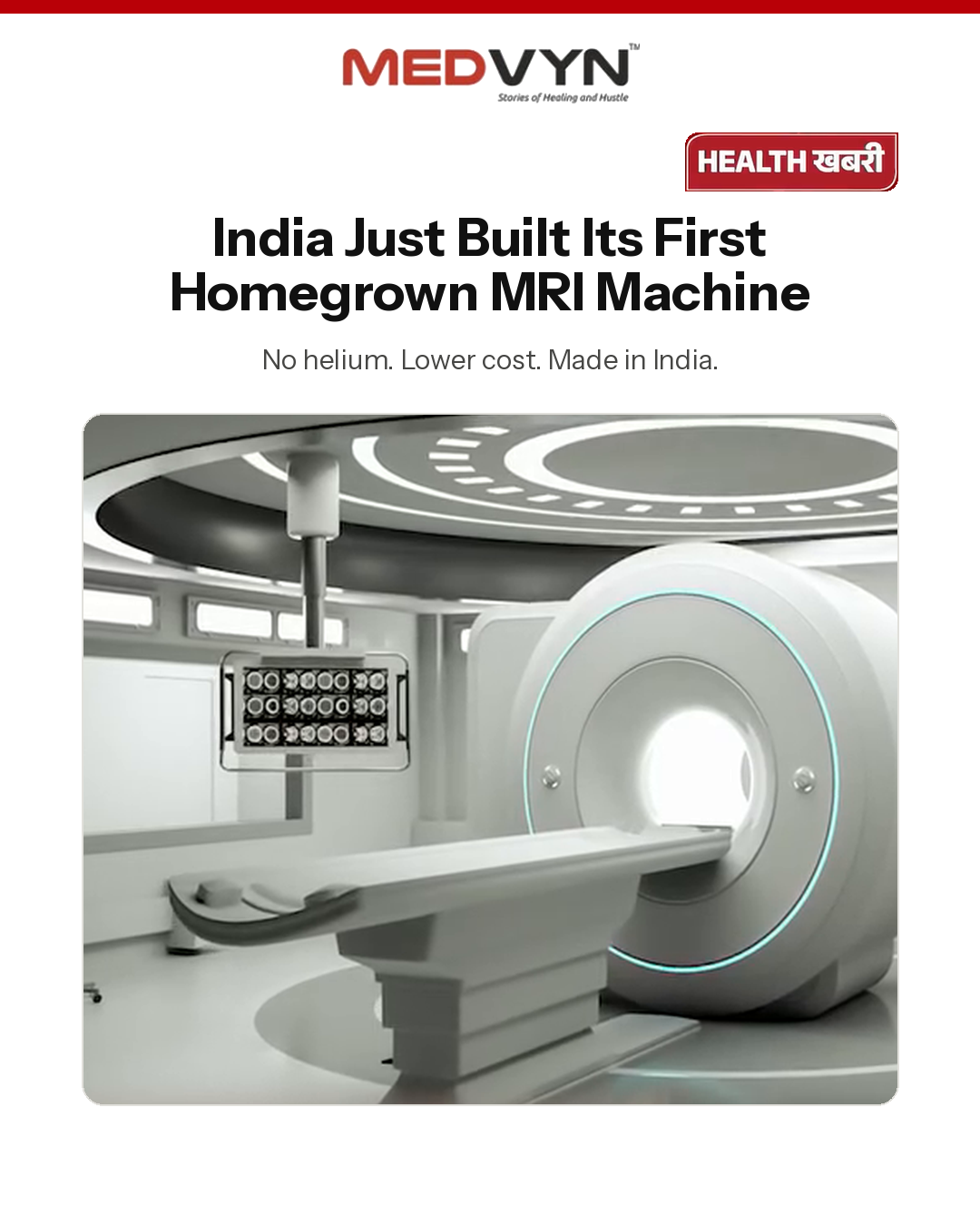
India’s first indigenous MRI scanner is no longer a prototype. A 1.5 Tesla machine built by Bengaluru startup VoxelGrids, backed by Zoho, is already being used to diagnose patients at a cancer hospital near Nagpur. It runs without liquid helium, weighs a fraction of a conventional scanner, and the company says it costs about 40% less to build.
India imports MRI equipment worth nearly ₹3,500 crore every year, so that combination matters. In this article, Medvyn explains what the machine is, who built it, how it works without liquid helium, and why it could make MRI scans more accessible in smaller cities and towns.
What is India’s indigenous MRI scanner?
It is a 1.5 Tesla magnetic resonance imaging (MRI) system designed and manufactured in India by VoxelGrids, a startup based in Bengaluru. Reports describe it as the country’s first fully indigenous MRI scanner. The 1.5 Tesla rating is the clinical standard field strength used in most hospitals, which means the machine is built to the same class as the scanners doctors already rely on for brain, spine, joint and cancer imaging.
MRI uses a strong magnetic field and radio waves, not ionising radiation, to create detailed images of soft tissue. That makes it one of the most useful diagnostic tools in modern medicine, and one of the most expensive to buy and run. Until now, hospitals in India have largely depended on imported scanners.
Who built it: VoxelGrids, Zoho and Tata Trusts
VoxelGrids is a deep-tech medical imaging startup in Bengaluru. According to YourStory, Zoho Corporation led a $5 million Series A round in the company in 2021, and Social Alpha is also an investor. Tata Trusts backed VoxelGrids through its development phase and placed an order for a machine, while Zoho founder Sridhar Vembu helped keep the company going when funding was tight.
The founder, Arjun Arunachalam, has said the machine is roughly 40% cheaper to build than imported systems, as reported by Digital Health News. The startup’s story is also a reminder that hardware medtech takes years of patient capital before a product reaches a hospital.
For more stories on homegrown medical technology, browse the medical technology news on Medvyn.
Key features of the VoxelGrids MRI scanner
Here is what the published reports say about the machine:
- Field strength: 1.5 Tesla, the clinical standard.
- Helium: the superconducting magnet does not rely on liquid helium.
- Weight: about two to three tonnes, compared with roughly six tonnes for a conventional system.
- Cost: about 40% lower manufacturing cost, according to the company.
- Energy use: reported to be significantly more energy-efficient than imported systems.
- First site: Chandrapur Cancer Care Foundation, near Nagpur in Maharashtra.
Together, these points target the three things that keep MRI out of smaller hospitals: purchase price, running cost and the space and infrastructure needed to install the machine.
Why a helium-free MRI matters
Most MRI scanners use a superconducting magnet, and that magnet has to be kept extremely cold. Conventional machines do this with liquid helium, a costly gas that India has to import. Helium prices and supply swings therefore feed directly into what hospitals pay to buy, install and maintain a scanner.
The VoxelGrids design removes that dependence. Electronics For You reports that the device does not rely on liquid helium, and Channel IAM adds that the design can use nitrogen instead of imported helium. That change is also what the company credits for much of the roughly 40% cost saving, alongside lower power consumption and fewer expensive inputs.
A lighter machine helps too. At about two to three tonnes against six, the scanner should be easier to transport and to place in buildings that were never designed for heavy imaging equipment.
First clinical use: Chandrapur Cancer Care Foundation
The first clinical installation is at the Chandrapur Cancer Care Foundation, near Nagpur. The scanner was unveiled there in December 2025 and is now used for patient diagnostics, according to YourStory. Coverage by The Ascendants from late December 2025 also names the Chandrapur site.
That matters because an MRI scanner is judged on real patients, not demos. A working installation in a cancer care setting shows the machine can handle everyday clinical use, which is the test any hospital buyer will look at first.
Why it matters for healthcare in India
Three effects stand out.
- Lower import dependence. India imports MRI equipment worth nearly ₹3,500 crore every year, according to Channel IAM. Even a partial shift to domestic manufacturing would keep part of that spending in the country.
- Access beyond big cities. The goal, as the same report describes it, is to expand MRI access in smaller cities and rural regions. A cheaper, lighter, helium-free scanner is far easier for a district hospital or a private diagnostic centre to justify.
- Lower scan prices over time. Channel IAM reports that the machine could eventually reduce MRI scan prices in India by up to 70%. That is a projection, not a measured result, but it shows how large the potential saving is for patients who currently travel or pay heavily for a scan.
For patients, the practical benefit is simple: a scan closer to home, with shorter waits, at a lower price. For hospitals, it offers the prospect of a domestic supplier for servicing and spare parts. You can follow more healthcare news from India on Medvyn.
What to watch next
The headline numbers deserve a careful reading. The roughly 40% cost saving is the company’s own figure, and The Ascendants notes that these claims have not yet been independently evaluated at scale. The same goes for the projected 70% fall in scan prices.
Three questions will decide how far this goes:
- Clinical performance: how image quality compares with leading imported 1.5 Tesla scanners across brain, spine and body scans.
- Production scale: whether VoxelGrids can build and service enough machines for hospitals beyond its first sites.
- Regulatory and buyer confidence: whether more hospitals, including government facilities, place orders after the first installations.
Until those answers arrive, the scanner is best seen as a promising and well-backed first step rather than a finished solution to India’s MRI gap.
Frequently asked questions
What is India’s first indigenous MRI scanner? It is a 1.5 Tesla MRI system developed and built by VoxelGrids, a Zoho-backed startup in Bengaluru. Reports describe it as the country’s first fully indigenous MRI scanner.
Does the VoxelGrids MRI use liquid helium? No. The superconducting magnet is designed to work without liquid helium, which is one of the main reasons the company says it costs less to build.
Where is the indigenous MRI scanner installed? The first clinical installation is at the Chandrapur Cancer Care Foundation near Nagpur, Maharashtra, where it is used for patient diagnostics.
How much cheaper is it than imported MRI machines? The company says its manufacturing cost is about 40% lower. This is a company claim and has not been independently evaluated at scale.
Is the scanner available in hospitals across India yet? Not widely, as far as published reports show. Chandrapur is the named first site, and Tata Trusts has placed an order for a machine. We did not find a confirmed list of other installations.
The bottom line
India’s first indigenous MRI scanner moves a long-discussed idea into a working hospital. It is a 1.5 Tesla, helium-free machine that weighs about two to three tonnes, is already in use near Nagpur, and is claimed to cost about 40% less to build than imported systems. If it performs at scale, it could cut import dependence and bring MRI within reach of hospitals that could never afford a scanner before. Medvyn will keep tracking clinical results and new installations, so keep an eye on our latest healthcare news.
Check out our latest post on Instagram and LinkedIn: